CAMP SKIPPING PIG SANCTUARY
Snactuary
Dawn Camp @Camp Skipping Pig
1776 Torrey Hill Rd
Java Center, NY 14082
fax: n/a
- Home
- COMMOM MYTHS in no particular order
- So You Want a Pet Pig!
- About Us
- Beginnings
- YOUR PIG NEEDS...
- WHY DOES MY PIG...?
- HEALTH NOTES
- WHEN YOUR PIG IS SICK...
- Did They Tell You About...
-
FEEDING FOR HEALTH

- PIG WEIGHTS
- MOVE THE PIG (correct bad behavior)
- GILBERT WAS AN ANGRY PIG
- FOR SAFETY'S SAKE...
- DOGS-VS-PIGS
- Hannah Blue and Tooey "Teacups"
- Bugsy
- "Spot"
- Tea Cup and Micro Mini Pigs
- Teacup Myths...NAMING NAMES
- Why Are Sanctuaries Needed?
- SO YOU NO LONGER WANT YOUR PIG
- LINKS
- Swilbur's Story
- Our American Heritage pigs
- ANGELINA AHP
- SNORKLE
- Lia, Burn Study Pig
- Meet the Kunekunes
- Contact Us
- ART WORK
- WHO IS KENYA ?
- SUDAN and TSAVO
- RED WATTLE HOGS
- sNYGYL
- Jack & Jill
- JOY
- SNURDLE
- PETER
- GIZMO
- HARLEY
- SPAMLET
- SNICKERS
- 'LIL WILLIE
- PIGGLES
- RICHARD & REGGIE
- LUCY
- SNIPPET
- SASSY
- Rosie
- Photo Page
- A BIG THANK YOU!
- THE CATS
- Available Pigs
HEALTH NOTES
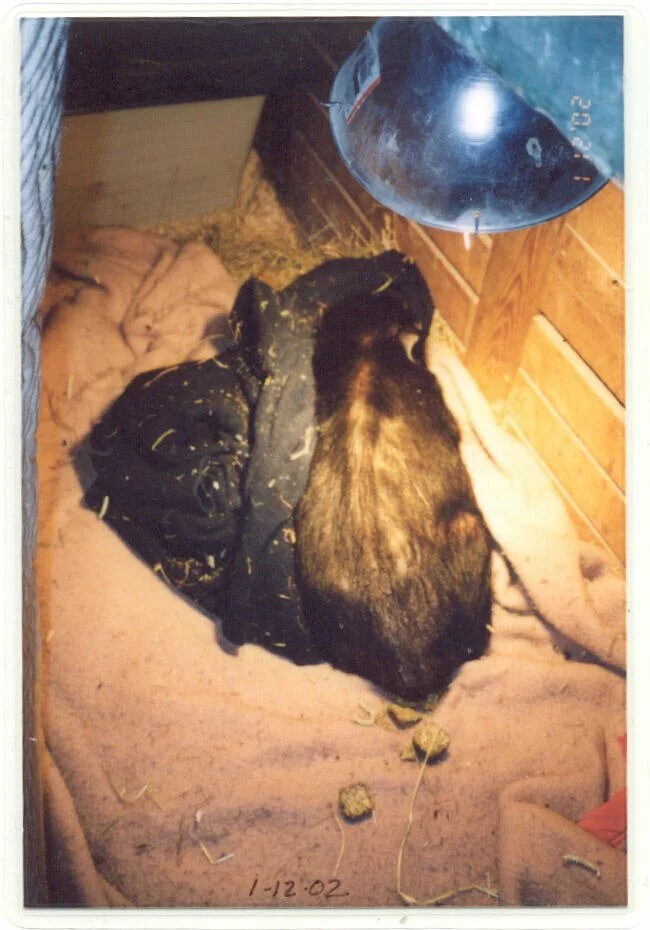
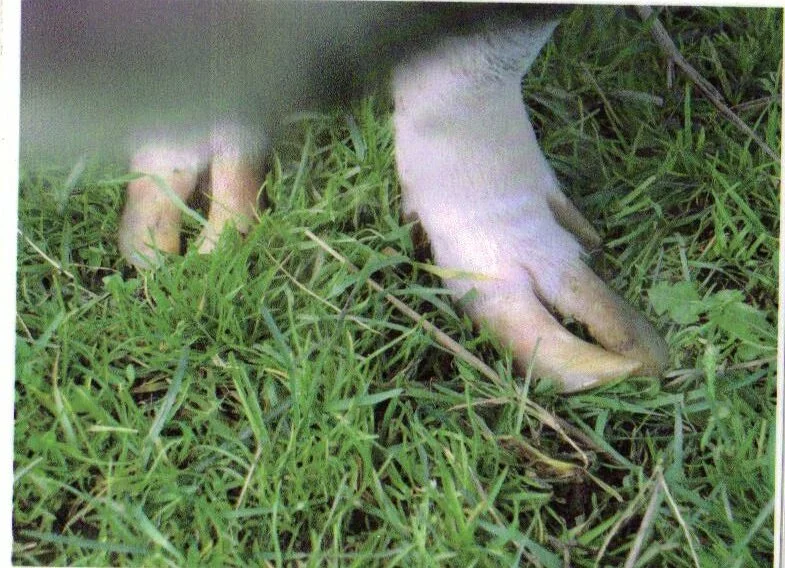
starvation...44 lbs and should be 130 feet need trimming
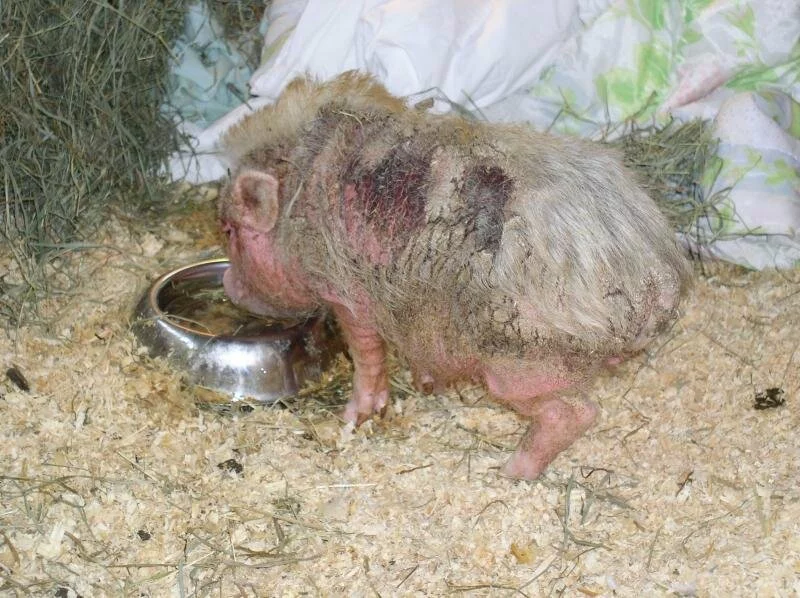
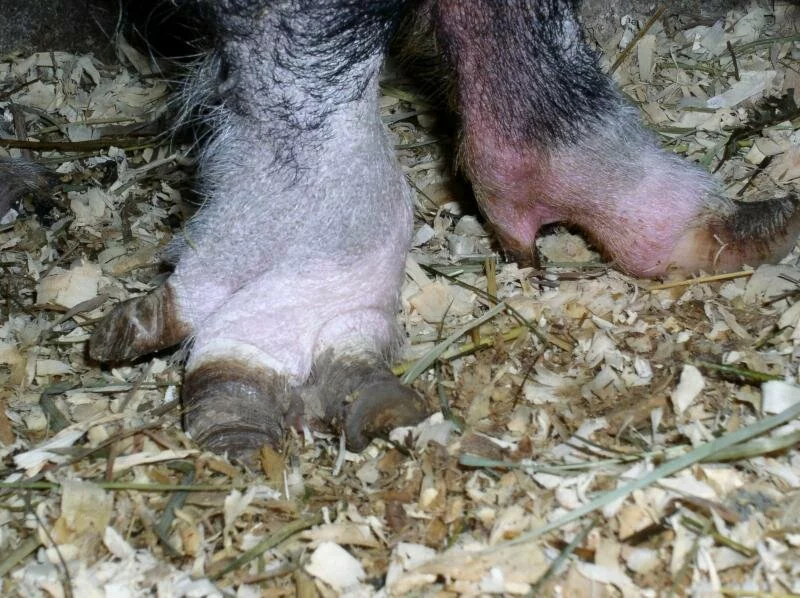
severe mange and starvation deformed leg 'cuz feet weren't trimmed
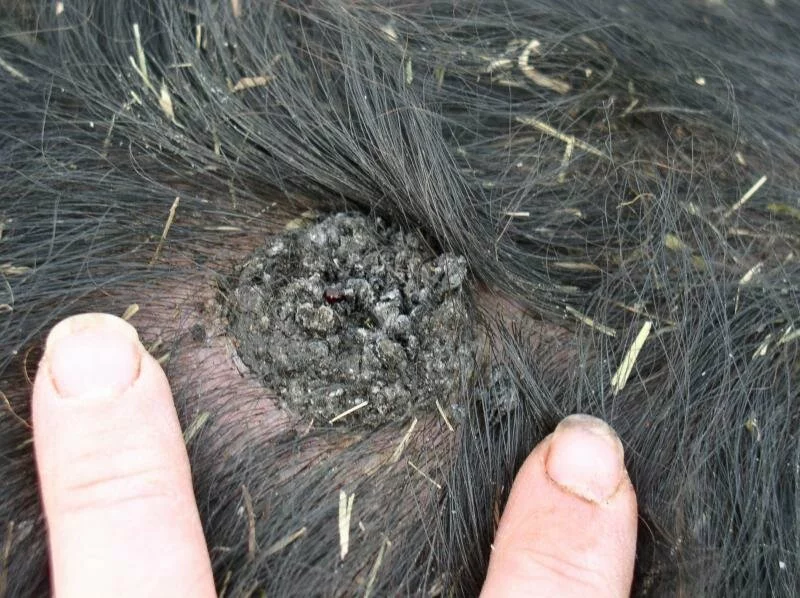
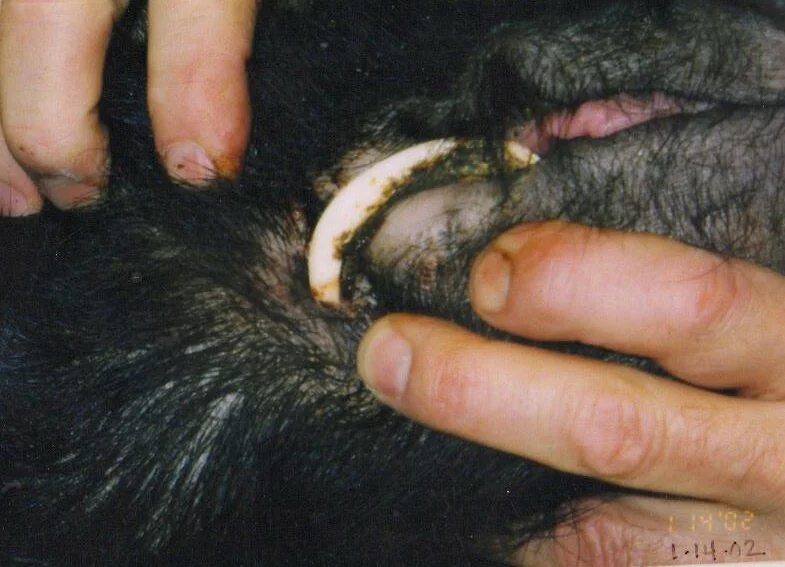
wart (porcine papilloma virus) untrimmed tusk growing 1/2" into face
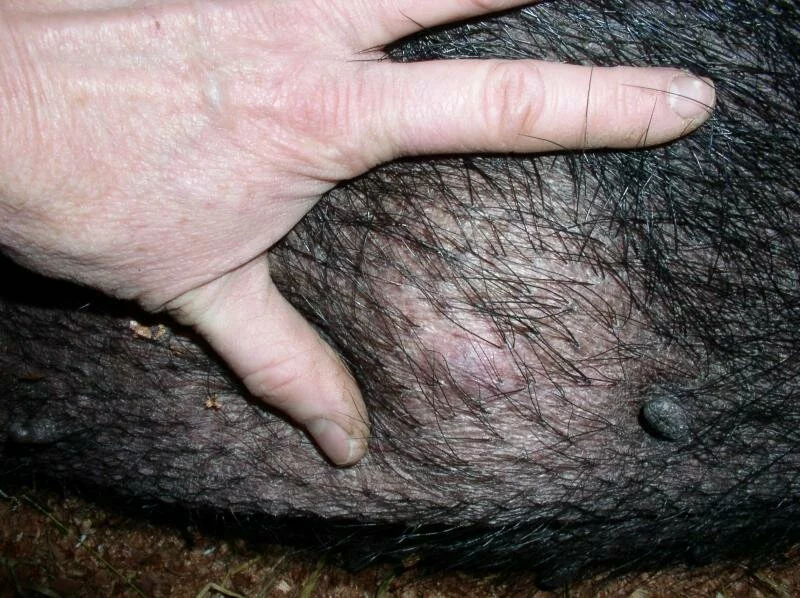
Mammary tumor. This tumor started out looking like a bug bite. At the time of its removal it was the size of a small orange and was deeply embedded in her body. The pinkish tumor had black running throughout and was called a melanoma by the vet.
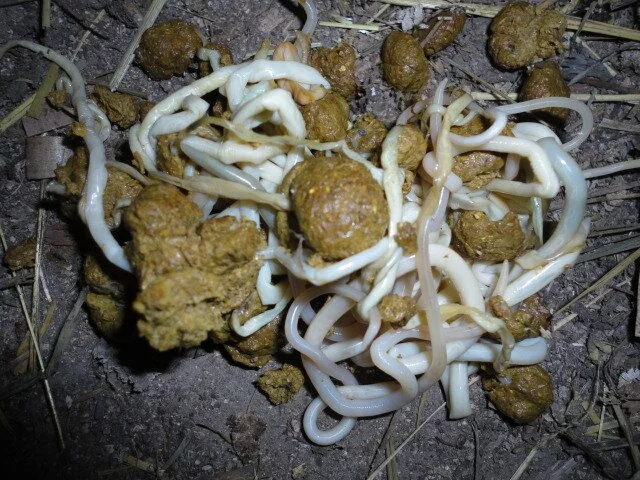
These roundworms were passed by an apparently otherwise healthy pig. Talk to your vet to determine the best program for your pig(s). Even individuals who live in a house need to be regularly dewormed. Always deworm new arrivals and even babies. They should be dewormed by the breeder, but do it yourself to be certain it is done. When I feed my pigs on the ground I try to change the location at each feeding and avoid muddy areas and manure. Pigs in overcrowded conditions or eating from the ground in dirty conditions will require more frequent dewormings than individuals in a house setting. A heavy infestation may or may not have outward signs, such as poor body condition or coat, poor appetite, cough, etc. Establish a regular program, mark the calendar and stick to it. Note, too, that unexplained coughing can also be cause by migrating worms.
Here is an interesting and important article from the CDC regarding ascariasis, a parasitic roundworm infection in humans...
http://www.cdc.gov/mmwr/preview/mmwrhtml/mm6220a6.htm?s_cid=mm6220a6_e
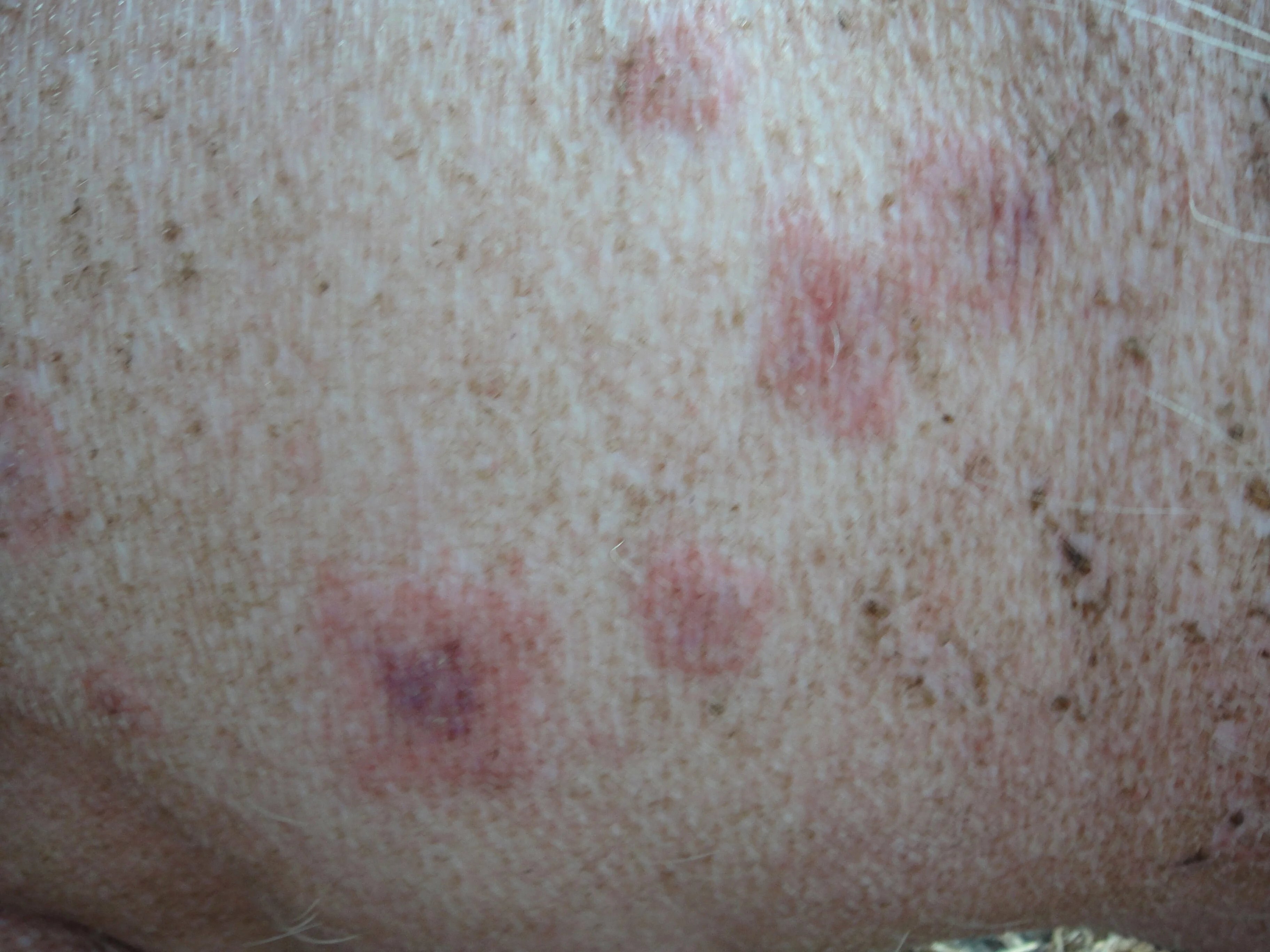
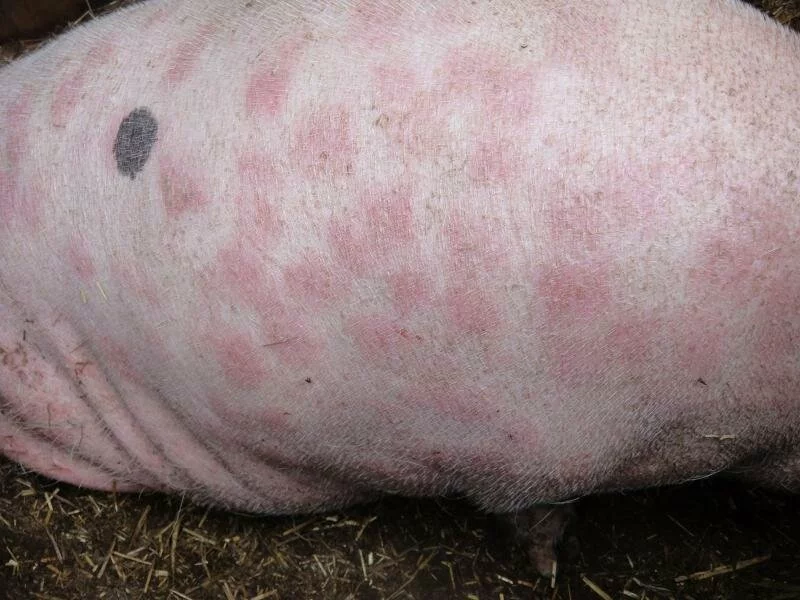
ERYSIPELAS VIDEO LINK
https://youtu.be/NQTxZMCtRKo
ERYSIPELAS LESIONS..note the diamond shape lesions (above) RED ALERT!!! SCROLL DOWN
VOMITING...RED ALERT!!!! Pigs don't normally vomit as a dog or cat might, If your pig is vomiting and reluctant to eat, a bowel blockage should be suspected. Only an examimation by your vet can determine if this is the case. An X-Ray can confirm if there is a blockage...most common in the bowel, but possible in the stomach. If your pig rips its blankets or if you give the pig plastic bags to play with, there is a risk. A pig might even block on a wad of grass if he is unable to chew properly. Dehydrated pigs or pigs who do not drink enough may also block. An untreated blockage is a death sentence. Waste no time getting the pig to a vet.
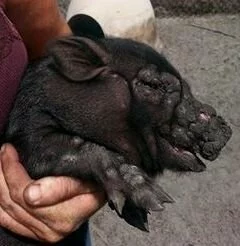
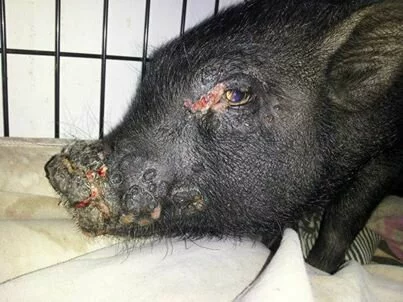
The photos below show two different piglets with staph/strep infections, per the owner. These require immediate treatment by a vet to determine which antibiotic will be most effective. Untreated, it can be fatal.
Dippity Pig generally shows up in younger (two years or less) pigs during times of stress and in early spring when first exposed to the sun. It may also appear in older pigs and at any time of year but it seems most common in the spring. There may also be a genetic connection because Hampton and his two brothers have all had it several times and the breeder's response upon inquiry was "oh, ANOTHER one has it now?" Hampton and his siblings (at different sanctuaries) all had it at least twice in the spring. In late July it popped up yet again on one of the boys. They are not under any stress and are happily settled in at the sanctuary. They are all over two years old, so the "usual" causes and time frames fly out the window with these boys. Most often there will be obvious lines across the back that ooze blood. It is very painful, causing the pig to dip its back, sometimes even causing the pig to collapse, screaming, to the ground. In a few days it will clear on its own, but pain meds will help your pig through the worst of it. Consult with your vet to determine which meds to use and if anything else needs to be done to make the pig more comfortable.Though painful affected pigs usually recover uneventfully within a few days. Housing him in a darkened, quiet place may help with the healing.
This link is a short video of a pig with Dippity Pig http://youtu.be/1Sq8ykcvBC4
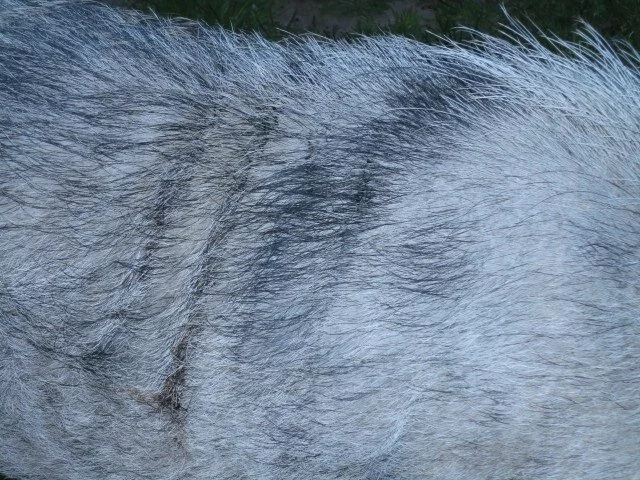
Photo of Hampton's back showing the lines
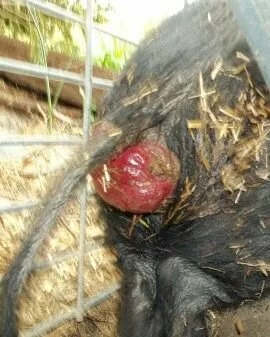
This photo shows a PROLAPSED RECTUM in a potbelly. It proved to be fatal. This is a RED ALERT condition and requires immediate treatment. It can be caused from straining or a crushing injury. Very sadly, this pig died because his owner delayed getting him treatment ( she had every excuse you can imagine) AND because when she finally did, she would not allow the vet to anesthetize him, for fear he would die from the anesthesia. Right...so the "vet", if he can be called that, cut and sutured this poor pig as he struggled and screamed and became even more shocky. Within two days of "treatment" he was dead.
The above photos are examples of some of the types of neglect and health problems we've encountered. Some are inexcusable and caused great suffering needlessly. Proper trimming of the feet in the second photo prevented leg deformity and the onset of arthritis. Because the pig is regularly turned out, his feet have pretty much maintained themselves. While confined to a house, he wasn't able to wear them down naturally. The pig in the fourth photo with the leg deformity isn't as lucky. She didn't have ideal conformation to begin with, and because her feet weren't kept properly trimmed as she grew, her leg now turns out at almost a right angle. She was born in 2001 and is showing signs of arthritis in her front legs. She is a real challenge to keep correctly trimmed because her feet no longer touch the ground as they should and don't wear evenly. There is simply no excuse for starvation and ingrown tusks (see sWilbur's story). Nor is there an excuse for the condition of the little pig with mange that looks like a burn victim (see Jack and Jill). Treatment would have been inexpensive and easy, but let go this far, the condition became life threatening, expensive and very time consuming to cure.
It is critical to contact a veterinarian when your pig appears sick or has unexplained spots, lesions, lameness, a lack of appetite and such. A pig that is TREMBLING may be either cold or in pain. Another sign of illness or discomfort is teeth grinding. Young pigs will also gring their teeth as the new ones emerge.
As a pig owner, you should have a vet lined up BEFORE the pig even comes home, let alone becomes ill. In many cases only immediate treatment will bring about a happy ending. There is no substitute for hands on by a competent vet...the Internet is NOT the place to seek out health advice for your pig, especially when it is something serious. All too often treatment is delayed while there is a great wringing of hands and comments such as "poor piggy", "I hope he feels better soon", I will pray for him", "Gee, I have no idea but it sure looks sore", "OMG that's AWFUL!"...etc...DO NOT DEPEND ON CHAT ROOMS, Face Book GROUPS AND THE LIKE FOR A DIAGNOSIS AND HELP!!! That kind of delay may very well be the death of your pig due to the wait for qualified treatment and/or completely inaccurate, often dangerous advice. The variety of opinions is always amazing, as are the suggestions for treatment, often offered up by inexperienced new owners. Most of us with experience will immediately advise the person to GET THE PIG TO A VET! We can try to help in the meantime, but WE ARE NOT VETS. And coconut oil and CBD oil are NOT cure-alls!!! Nor is canned pumpkin. Valuable time can be lost while attempting to make things better with one of these options.
Though we may share our experiences, opinions, how we handled certain situations, etc, there is NO SUBSTITUTE for the animal being seen by a qualified vet. Any delay could be fatal to your pig.
OBESITY may kill m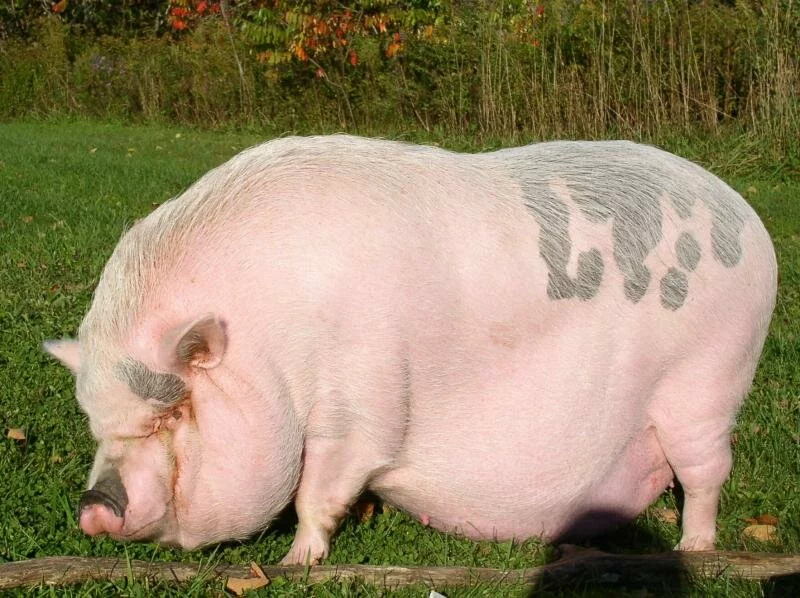 ore pet pigs than any other health problem. As with people, arthritis, heart and breathing issues develop in obese pigs. There is no excuse to let a pig become so heavy that its belly touches, let alone, drags on the ground. This is as cruel as if he were starved...either way causes a prolonged death. I've seen pigs whose bellies drag on the ground between their hind legs and are injured from abrasions and being stepped on. Why do people think it's "cute" for a pig to be fat?! With any living being, proper diet and enough exercise are critical to a long healthy life. Every pound of fat requires an extensive network of blood vessels to support it. This causes the heart to work harder, increasing the strain on it and shortening the pig's life by half or more. If the pig survives up to or past that point, the quality of his life is very poor. Most are blind and deaf and the majority become nasty and snappy because they are so miserable. An obese pig is almost guaranteed to develop arthritis as he ages because of the stress on his joints. I believe that pigs can and do suffer from depression (see Harley's story), and what could be more depressing than being trapped in a body that you can't carry around as you slowly suffocate and become deaf, blind and crippled? Pigs are "programmed" to eat and it is our responsibility as their caretakers to feed them reasonable amounts of a balanced diet combined with lots of exercise to keep them healthy and fit. Think of what the pig's activity level would be in a natural environment. Even if you take your pig for regular walks, it must not be overfed. It'll never be able to shed those excess pounds during a walk without a controlled, balanced diet. An obese pig's droppings may be so tiny as to be the size of a rabbit's or a goat's (about 1/2"), and hard and dry. Normal is generally a firm, moist ball an inch or so in diameter. Pigs getting a high fiber diet may have a larger, softer stool that may not form balls, especially if out on grass. One of my methods to help an obese pig lose weight is to scatter its small meals over a large area on the ground, forcing it to move about and search for the pelleted food. This is more natural for the pig, it gets him moving, and it gives him something to do for more time than if he scarfed his dinner out of a dish in a minute or two. I also cut back the quantity and eliminate all junk food. A treat ball is a good option. The pig will spend a lot of time rolling it around as the pellets are dispensed in tiny amounts. However, we've found that most pigs soon figure out how to push the treat ball into a corner, run it up the wall or fence and drop it, over and over. This dispenses the treats without a lot of walking around. And people think animals are dumb! One pig that came here for a few months had been on a diet of three peanut butter sandwiches and three cups of dog food a day! I was horrified when I first saw her. She was unable to shuffle more than ten or fifteen feet at a time and would collapse, gasping after those few steps and stay down for a good ten minutes before moving again. When she came off the trailer at our house I thought she'd die right then. She collapsed, gasping at the bottom of the ramp. The eight mile trailer ride had almost done her in. She was blind, deaf and extremely unhappy. Her face was so huge that she couldn't drink water from even a shallow dish because her jowls would tip it over before she could get a sip. She was watered several times a day in a time consuming process using a large syringe. Her eyes were so embedded in fat that she was totally blind. They couldn't be properly cleaned, were caked with dried on brown tears and dirt and smelled terrible. Her ears were so caked and clogged with crud that they were painful and she wouldn't let us near them. It was impossible to get her to eat her pig pellets, so at first they were mixed with a teaspoon of watered down peanut butter and a few pieces of mashed dog food. Even then, it was weeks before she'd try to pick at healthy food. All fruits and veggies were refused. Her droppings were rabbit size and consistency. By the time she went home after several months, she was eating 1/2 cup of Mazuri Senior three times a day and slowly losing weight. Though still not normal, her droppings had doubled in size and she was able to move around much more easily. She would spend 15 to 20 minutes on her feet at a time and was no longer gasping for breath when she walked. She was able to drink out of a large, low, non-tip dish. Her overall attitude and condition were much better. Within a month after she went back to her people she was back on dog food and peanut butter sandwiches. Within a year she'd died...again obese, blind, deaf and miserable, trapped in a body she couldn't use. This pig was only six years old and should have been in her prime, able to move freely, run and enjoy life. Instead she was dead, and the owner almost gave himself a heart attack dragging her 300 pounds on a tarp to the back yard for burial. This pig had lived at least three quarters of her life trapped in a body that
 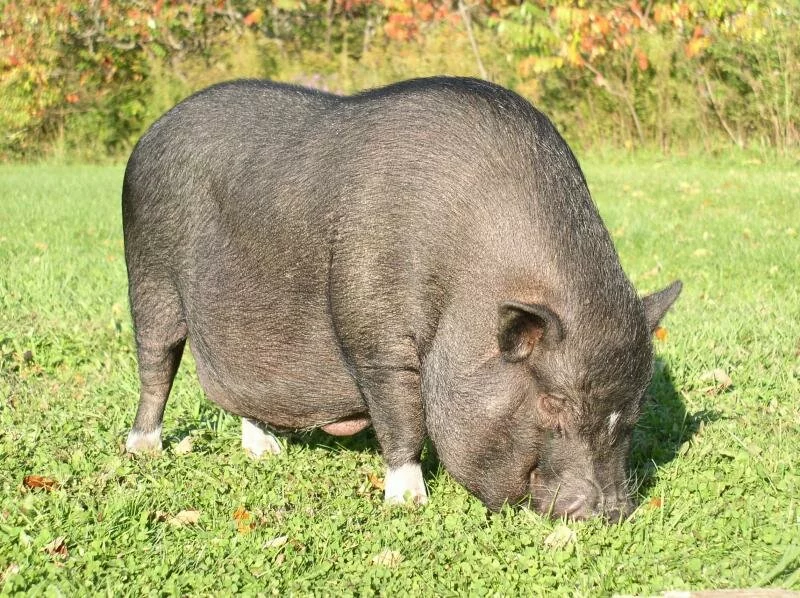 wouldn't let her do "pig things" and there's simply no excuse. There are countless pigs suffering as she did. Fat is never "cute" and allowing a pet to get to this condition is shameful on the owner's part and causes prolonged suffering and an early death for the pig.
This obese pig has a hernia, further increasing his risk of a premature death.
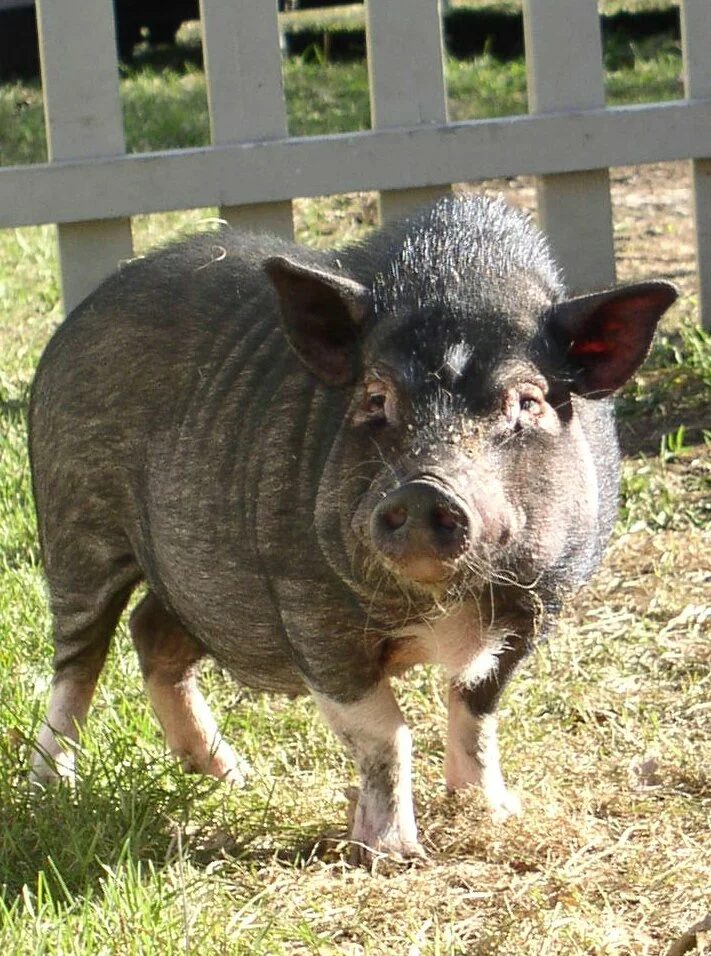
Zoe is at a healthy weight. Note the distance between her belly and the ground. She is nicely round and able to live an active life. One should never be able to see the pig's hip bones, spine or shoulder blades.
LAMENESS may be caused from a mis-step, jumping on and off furniture, rough play, or over exercise and might be a simple bruise, strain or sprain, cut, puncture wound, or something as serious as a fracture or broken bone. Provide ramps for your pig and discourage jumping of any kind. NEVER teach your pig to sit up, as this could cause a break in his hind leg. Check for heat and swelling and encourage rest. If your pig refuses to walk or bear weight on a leg it's wise to have an x-ray done. If the lameness comes on suddenly, suspect a recent injury such as a strain or sprain. If it comes and goes and starts out as a vague unsoundness you might suspect the beginning stages of arthritis and treat him appropriately. Consult with your vet to determine the cause and appropriate treatment.
Many pigs develop ARTHRITIS, especially in their backs or elbows. Being overweight isn't always the cause. It may be genetics or conformation or the result of an injury. Do not let your young pig jump off a couch or anything of similar height. Ramps are better than steps and stairs. If you see your pig moving with a shortened stride, mincing along and not as willing to run or walk as he used to be, you should suspect arthritis. X-rays will confirm the condition and location, and your vet will help determine the best course of treatment to ease the discomfort and improve your pig's quality of life. As the condition progresses your pig may spend time on his knees, eventually "walking" on them most of the time, or resting on them to eat and graze. We've used each of the following at different times, with varying degrees of success to help our arthritic pigs...aspirin, turmeric, glycosaminoglycans injections, prednisone, Bute and carafate, and Tramadol tablets. Different medications seem to help different pigs sharing the same problem. You may need to try a couple before finding the one that best works for your pig's pain. Deeply padded beds help and Snippet especially likes her bed that once was a cot at a day care facility. A ramp up to the cot's level keeps her from making a 6" step up or down. Ramps into the barn and onto the porch also ease her movement to different areas. Rubber mats, some with bubbles, protect her from the harshness of the concrete floor in the barn. A donated fluffy down comforter under a heat lamp has been another favorite of hers. Your pig should never be directly on concrete. A wooden pallet will allow the pig to sleep up and away from the floor, and rubber mats will soften the footing. Avoid cold and damp sleeping areas. Warm, dry and well padded will keep the pig more comfortable, just as it would you.
URINARY BLOCKAGES aren't uncommon in neutered male pigs. These can quickly become life threatening and even if only suspected, must be treated as an emergency. Often the pig may appear to be lame in one hind leg, holding it forward, touching the toe down, standing with it out to a side, etc. In my limited experience, both pigs who developed blockages appeared to favor their right hind leg. Initially the pig may eat well and the owner may lean toward a lameness diagnosis or a back injury. It is especially important to watch the pig closely for any sign of straining to urinate (such as a thrusting/pumping motion, or hunched back stance) and to put the pig in an area where urine output can be monitored, away from other pigs who may confuse the issue with contributions of their own. I've found that bare concrete in the toilet area or fine sawdust gives me a good idea as to the quantity produced. It shows small dribbles, large drops and good puddles, almost like a clumping cat litter. You may notice that your pig has a somewhat bloated look, unless he's obese to begin with. It's a good idea to have PH test strips on hand and to acclimate your pig to being tested. Simply reach under his belly as he "goes" and reward him for standing still. Then when you do need to test his PH he won't think your behavior is odd and the testing will be easy. Do not let the strip touch either the pig or the floor/ground, or your results won't be accurate. Also don't let the strip be exposed to the air for too long before dipping it in the urine. I've noticed they change color within a few minutes when exposed to the air in the barn. We tried to maintain sNygyl's PH at 6. Too high or too low can create crystals that will cause a blockage. To keep him at 6 to 6.5, we added ammonium chloride and 99% DL methionine to his meals. He was fed three small high protein meals a day to space it out. We'd often go a month between tests as long as things were flowing freely, and diet changes were very rare. We don't mess with what works. One discovery we made is that sometimes a very low dose of Rompun relaxed sNygyl just enough to let him pass urine without making him at all groggy. Other times I've taken him for a trailer ride and it has helped. This trick was discovered after a couple of emergency trips to the clinic where he presented the vets with a giant puddle before they could examine him. Perhaps the motion and stress of the trailer ride was enough to get things flowing again. I've also had to massage him for up to 45 minutes to help him pass urine. It once helped him enough that he actually got up, urinated a little bit and then came back, laid down next to me and lifted a hind leg to continue the massage. I start with a very gentle scratch to "ask" him if he wants one. If he's very uncomfortable he'll spin and snap, but persistence usually pays off and he'll flop down for a belly rub. I start very gently and build the pressure until I'm using my fist and working from a couple inches below his rectum, between his hind legs to his navel. I use a circular motion and apply a good amount of pressure...as much as he'll tolerate. Not fun, somewhat tiring, but often successful. Again, urinary tract blockages can be deadly. If you even suspect one, contact your vet immediately.
BEANS may also cause urinary blockage symptoms.These collect in the prepuce and can cause a lot of discomfort for your pig. We've even found these attached to sNygyl's hairs and massaging him with baby oil or mineral oil seems to help him pass these stones. It's not a pleasant job and I'd suggest using doubled latex gloves as the urine can have a very strong odor. Your pig may not cooperate and it might take some gentle persuasion to convince him it's a good idea. Try to gently massage the mineral oil into the prepuce to help any beans pass. sNygyl actually learned to come and ask when he needed this attention. At first he was very disagreeable, but soon understood that it helped and he felt better afterward.
On the day after his tusks were trimmed, Swilbur began his day screaming in pain. My assumption was that his mouth was sore or a tusk had been trimmed too short, exposing a nerve, though we've never had a problem before with the procedure. A return trip to the clinic showed absolutely nothing wrong with his mouth or teeth, other than some normal tarter buildup. X-rays of his neck revealed a little bit of arthritis, but the pain had come on suddenly and was severe. The arthritis had been developing for some time. For a few days I tried to manage Swilbur's pain, but he was in agony and becoming unwilling to eat. Again he went to the clinic, and again nothing showed up as the cause. I mentioned to his vet that his left eye seemed swollen and somewhat pussy, though an exam of the eye showed it to be normal with no obvious injury. We began treatment with an ointment as a precaution. The pain would come and go, but Swilbur began to lose weight as we tried to find the cause. About 8 days after the pain started we were again at the clinic to show Dr. Dave how the cartilage in Swilbur's ears had become very soft, causing them to droop. Even the thicker cartilage at the top was becoming softer. Of even more concern, his tongue was now starting to hang out of the right side of his mouth. I was somewhat managing his discomfort with a low dose of bute and carafate to protect his stomach. On an especially bad day I shared a couple of Snippet's Tramadol tablets with Swilbur to get him through. At this point Dr Dave determined that our problem wasn't tooth related and a LESION or ABCESS of some sort behind his eye was the culprit. Swilbur was started on SMZ-TMP twice a day and we went for two weeks with that. Gradually the bute was eliminated and he showed a lot of improvement. The pain was gone and he had his excited to eat attitude back. About five days after stopping the SMZ-TMP, Swilbur's eye was swollen and pussy again and he had a red mark on his cheek. I treated his eye and feared we were going downhill again, but finally determined the cause this time was a bee sting. Within a few weeks his ears firmed up to 95% of normal and his eye fully opened. He was back to his normal happy self a month after it all started. The timing of the lesion with his tusk trim was a coincidence which made it easy to suspect a tooth problem.
DIARRHEA can be caused by many things, including parasites, diet, an illness, poisoning, overindulging, an allergy, and more. It can be difficult to determine the cause, but in the meantime prompt treatment is a must. While you're determining the cause your pig may become dehydrated and the condition can be life threatening. If it goes for over a day, contact your vet for diagnosis. Support your pig with plenty of water and electrolytes, using an oral syringe if he won't drink on his own. I've had good success with Pedialite and have found that most like the taste if they feel well enough to eat. You can also purchase unflavored. Be sure your pig has plenty of fiber in its diet. In addition to grass and hay, this might include pumpkin (you can use plain pie filling from a can), bran, wheat germ, or oatmeal. All of our pigs enjoy hay as a regular part of their winter diet. They also like the hay extender pellets, which are about 20% fiber. One "cure all" which is known as "Katie's Liquid Cork" has successfully stopped the "runs" in several cases. Mix two cups live bacterial yogurt with two mashed bananas and two tablespoons of fiber, such as wheat germ or bran. You can feed this multiple times, as necessary. This produced excellent results when Swilbur developed a severe case of watery diarrhea and became extremely weak . We never were able to determine the cause, but Katie's concoction no doubt saved his life. Though he didn't want to eat, I was able to administer the mix with an oral syringe and much patience. As he began to feel better he ate it from a spoon. Be careful not to overdo the treatment, though, as it could cause constipation.
CONSTIPATION might be caused by a lack of fiber in the diet or too little water. Providing your pig with good quality pasture or hay and a constant source of fresh water will go a long way in preventing constipation. If your pig is not a good drinker, some fruit juice can be added to flavor the water to encourage drinking. Exercise is also very important. Things tend to keep moving if piggy keeps moving! If he does have a problem, plain pumpkin pie filling is usually a tasty way to provide fiber. Most pigs love it and the problem is generally solved fairly quickly. Offering a cup at each meal will get him off to a good start. It's a good idea to keep a can on hand for "medicinal purposes". Bran added to his meal is also another good source of fiber, though some pigs will not eat it as eagerly as the pumpkin. It is dry and "fluffy" and not very palatable if just added dry to his regular meal. Another good source of fiber, though they shouldn't be used as the sole source, are hay pellets, which are usually about 20% fiber. Other long stem forage such as hay or pasture should also be offered. If adding fiber to the diet produces no results an enema may be in order. These are in syringe form and may be purchases at your vet clinic. These usually resolve the problem. If an enema does not produce a bowel movement contact your vet as the problem might be more serious. See below...bowel stricture. If a stricture or blockage IS suspected, DO NOT administer an enema. DO NOT administer an enema if the pig is vomiting, as vomiting is an indication of a possible blockage. The straining caused by an enema may make matters worse. Blockages and bowel strictures are life threatening and require immediate treatment to save the pig. If your pig tends to rip apart blankets and chew inappropriate things, remove them and offer only hay or straw or non-destructable bedding. Ingested fabric or plastic may cause a blockage and if a non-pooping and/or vomiting pig is guilty of tearing these items up, a blockage should be suspected.
BACK INJURIES can be very painful for your pig and frustrating to treat and life threatening if left untreated. Keeping a pig's weight in check can go a long way to prevent an injury, but is no guarantee. Do not let your young pig jump on and off furniture, as this may cause an injury. Avoid stairs and big steps. Some signs of a back problem may include an unwillingness to walk or negotiate steps or uneven ground, even paralysis of the hind quarters. A back injury may show up as a hind toe dragging or the pig may be down and unable to move it's hind quarters. Its back may twist to one side and if able to walk at all it may walk sideways or drag its hind quarters. A pig's hind legs may slip and splay out, as Bradford's did. Only your vet can determine the severity of the problem and the proper course of treatment, which usually begins with pain meds and dexamethasone injections. A sling might be of use to help the pig remain mobile as its back recovers. I used a 10' round sliding door track and a trolley to suspend Red Wind. With her hind quarters paralyzed, the trolley allowed her to be supported and she could freely move about in a 5 1/2' x 10' special needs stall. It is important to support the entire belly with a well padded sling to avoid too much pressure in one spot. A narrow sling will roll and slip. I've had good luck with several wide neoprene equine cinches padded with a thick folded blanket. Of course a male pig will need an opening in the sling large enough to allow for urination and to prevent the sling from becoming urine soaked, which would cause a scald. It is critical to check the pig for rubs and pinched areas no less than twice a day. Watch for signs that the sling has shifted. The pig cannot be kept in a sling full time as tissue damage will result. Rubber mats and good bedding will help prevent sores from lying in one place. It's important to roll and move the recumbent pig often to prevent nerve and tissue damage. Red Wind's hind legs dragged so it was necessary to wrap her lower legs to prevent abrasions as she moved about. In order to keep the wraps in place I wrapped above the hock. Vet wrap works well, but be careful not to over tighten it. It will take two strong people and some "playing around" to get the sling all adjusted, properly balanced, and the pig comfortable. A non-harness trained pig might be panicky when first suspended, but will likely soon realize that life has improved. Watch your pig for signs of depression and be sure to offer a shovelful of sod every day for rooting and boredom relief. An old couch cushion will make a good mattress for your pig to rest on. Patience and prevention are two key words when dealing with back problems for both humans and our porcine pals. It can take weeks of patient and diligent treatment to resolve a back problem. Despite our best efforts the pig may fail to recover and euthanasia may be necessary. Managing a paralyzed pig in a sling is extremely time consuming and physically taxing. Keeping a susceptible pig comfortable with a heat lamp during the winter may prevent a flare up. Once our "problem children" go to bed I cover them with a good blanket or comforter to keep away any potential drafts. They learn quickly that it's a good thing and seem to appreciate the help covering up. Heat lamps are provided as well.
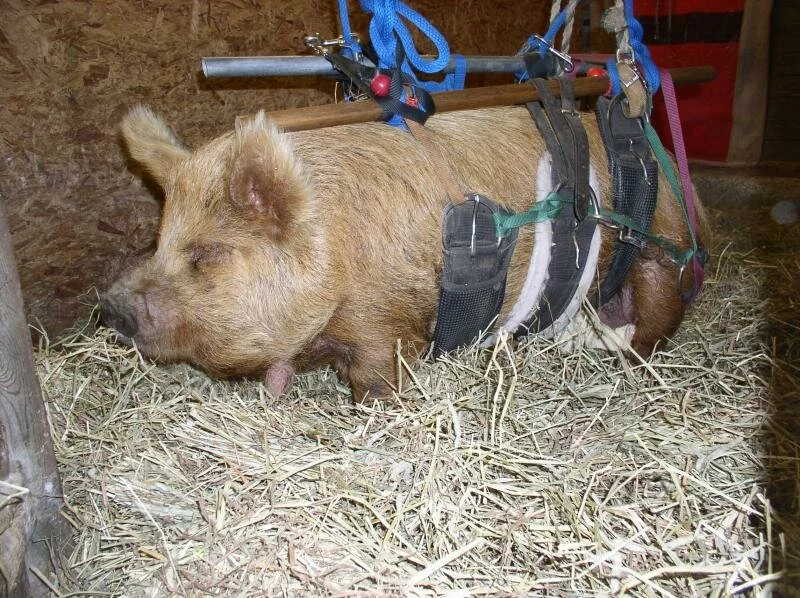
Sadly, despite preventative medications, we lost Red Wind to complications from ulcers. Her stomach was well protected but she developed ulcers in her bowel. A cart that would have allowed her freedom to move about was in the planning stage. The cause of her back injury was not determined, though it was her third flare-up.
Bradford was almost euthanized when his back issues weren't being resolved after an eight week struggle. Nothing was helping, including rounds of Prednisone, and he was down, incontinent and miserable. In a last ditch attempt to save him I tried giving him Turmeric with a Saturday evening meal. When it seemingly was failing to help as well, I sadly called the vet on Monday morning to have him put down. His suffering had not been eased by any of our attempts and we'd run out of options. Dr Ted was scheduled to come on Monday about noon, but was delayed with an emergency call. Instead he planned to come about 2ish. Again he was delayed and called to say it'd be after 4 before he could get here. Around 3 PM Don went to the barn to check on Brad and was shocked to find him up and working on making his bed. This was the first time he'd been active in a couple of months and he worked away for over an hour and a half! When Dr Ted again called to say he was on his way, Don told him what Brad was up and all plans to put him down were cancelled. I believe the turmeric saved his life, as nothing else had begun to help him. He slowly progressed, and except for a couple of minor bouts of pain that we resolved with a short round of Pred, was trouble free for several years. Brad had another 15 minutes of fame when I wrote to the People's Pharmacy and told them of our success with turmeric after reading of how it had helped different people. His story was featured in their column and on their website. Brad has a heat lamp available all winter and is tucked in under several blankets every night after chores. One key to keeping him pain free is to keep his back warm.
ULCERS are fairly common in pigs and should be suspected if your pig goes off its feed and becomes lethargic, grumpy or depressed for more than 24 hours. If he's being treated for another illness an ulcer may develop from the stress or because he hasn't eaten . It is often a good idea to just give the ulcer medication as a precaution. Carafate coats and protects. Famotadine or Omeprazole reduce acid. Do not give together, as they will work against each other and not be of help. Give them separately at least 6 hours apart. You may find his abdomen is painful when pressed. When he's not eating, the stool moves more slowly thru the intestines and more moisture is absorbed, making the stool harder than normal. It might also contain blood from the ulcer, causing it to be quite dark, even black. If there is bright red blood (frank blood) in the stool the bleeding is within the bowel and another cause should be suspected. Your pig may become constipated due to the hard stools, requiring an enema to help things along. Offer plenty of water, high moisture and high fiber (canned pumpkin) food and encourage him to drink by flavoring his water if necessary. An ulcer might be caused from stress, medication, diet or other unknown reasons, but it is critical to begin treatment promptly. If you are giving your pig a medication that can be hard on the stomach, such as Prednisone or Banamine, some protection will be gained by administering carafate (coats the stomach) or famotadine or omeprazole (reduces acid) to protect the stomach. If the ulcer is already formed, Tagament works well to begin the healing process. It is important to follow your vet's recommendation as to medication, dosage, frequency and duration of treatment. Repeating, you should not give carafate and omeprazole/famotadine at the same time, as the coating will make the acid recucer ineffective.
ABCESSES most frequently occur on your pig's jowl or the side of his face. They may be caused by a tooth issue. Some pigs may be prone to them and others will never have a problem. Consult with your vet to determine the most effective treatment and the cause. Hot packs will encourage it to break and your vet may recommend a course of antibiotics, flushing the wound, or other treatment. You'll first notice a small painless round lump that grows progressively larger. It will begin to irritate the pig, causing him to rub it. Eventually it will develop a soft center and break and drain, but may recur if untreated. Even with treatment, another may occur, either in the same location or another. If located along the side of the mouth in the area of the teeth, you should check for a tooth problem. It may be necessary to extract a bad tooth to resolve the problem and relieve your pig's discomfort. Untreated, an abscess will eventually invade the bone, making treatment especially complicated and expensive or impossible. Also, what may appear to be an abscess could also be a tumor and it is important to know the difference and consult with your vet to determine proper treatment.
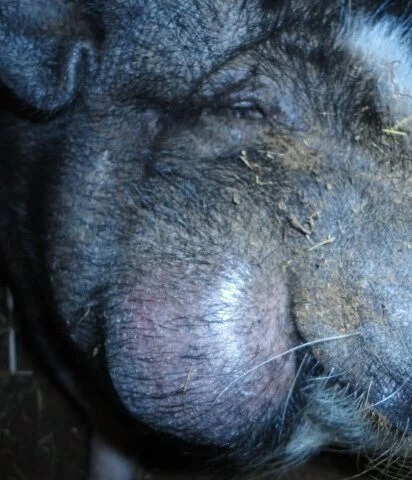
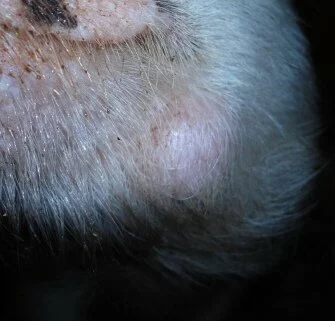
EYE INJURIES may occur as your pig roots about in tall weeds, from a wayward piece of hay, insects, airborne debris, straw barbs, wood shavings used as bedding and more. Generally, if an eye is swollen and painful, either Terramycin or NeoPolyBac ointment are safe, healing and soothing. If there is an actual injury to the cornea, such as a scratch, NEVER use an ointment with a steroid, such as NeoPolyDex. Consult with your vet to determine the best course of treatment. I try to keep a small tube of each ointment on hand, but rarely use the one containing the steroid unless specifically prescribed by my vet. Obese pigs may have continual eye drainage as will pigs with entropion. Weight loss will help the obese pig and surgery can correct entropion. Breeders should NEVER breed pigs with entroption, as it will likely be passed to the next generation.
SALT POISONING is a very big risk if you let your pig have access to salty foods such as chips, pretzels and the like OR, if water has been restricted or withheld. Pigs cannot sweat, so cannot effectively eliminate salt from their systems. A dehydrated pig who is given access to a lot of water may suffer from salt poisoning. The water causes cells to swell, including brain cells, which can lead to brain damage, blindness and/or death. One sign of neurological problems is head pressing, where the pig will stand with his head pressed against a wall. The pig may be down and unable to rise. A pig may also over indulge on a salt lick, though most will not, so it is ill advised to put one where a pig can access it. Salt poisoning is a life threatening illness and you must contact your vet or a poison control center for help immediately. Prognosis will depend on the severity and length of time passed before help is sought. If the pig has been without water for a long period DO NOT let it drink as much as it wants. Offer water in small increments (1/4 cup) at a time every half hour to hour until the pig is rehydrated. Allowing it to drink its fill at once could kill it.
BOWEL STRICTURES and INTESTINAL BLOCKAGES : Bowel strictures and blockages require immediate veterinary intervention for a good outcome. Strictures may present with a variety of symptoms such as constipation and/or rectal bleeding. Blockages may be indicated by vomiting, lack of appetite and decreased production of manure as what is able to pass does so and the rest remains stuck. Administering fluids (SQ, IV or rectally) may help soften a blockage if it is caused by an impaction of dry manure. If it is a foreign object, surgery will probably be necessary. NEVER delay contacting a vet if you suspect a blockage and your pig is vomiting.
On the evening of July 22, 2009 Ahurei was found down and bleeding badly from his bowel. Possible causes were thought to be a poisoning (possibly blue-green algae), salmonella or trauma. Initially 'Urei was treated with charcoal, antibiotics and a low dose of banamine for pain. We tried to administer fluids by an ear vein but had no luck. (That procedure can be very difficult at best when not in a clinic situation, and even at the clinic might be difficult). The attending veterinarian left and said to see how he looked in the AM. By morning he seemed almost comatose and didn't respond to any painful stimulation. I called my regular vet to have him put down as it appeared very hopeless. In the meantime I figured there'd be no harm in administering more antibiotic, charcoal and Banamine. By the time Dave arrived Ahurei was twitching an ear, so we decided to get him to the clinic for another to attempt to administer fluids. This was done thru the abdominal wall. He was given anti-ulcer medication as well as more antibiotics. The Banamine was stopped, as it can be very irritating to the stomach. 'Urei came home the following day but was off his feed for a couple more days. By Monday the 27th his appetite was back, he ate well and seemed on the road to recovery. However on Tuesday he was not eating again and on Wednesday he was rushed to Cornell Large Animal Hospital in Ithaca. On the evening of his arrival fluids were administered via his bowel and a general physical was done. His vitals were all pretty normal, he was active and alert. The next morning 'Urei was put under general anesthesia and a Barium x-ray showed that he had a bowel stricture. One possible cause might be trauma (he was living with two small Kunekune boars...so that was ruled out). Salmonella was another possibility, but tests were negative, quitepossily due to the antibiotics he'd been given. Erysipelas was yet another possibility but was also ruled out. While under general anesthesia a balloon was inserted into his bowel. The balloon was filled with water and left in place for 5-10 minutes to stretch the bowl. After a few days of hospitalization and producing normal bowel movements 'Urei was discharged with a prognosis of "guarded to fair". When dogs have the same problem and are treated in the same manner, it might require 7-8 treatments to bring about a full recovery. As this procedure hadn't yet been done to a pig, his prognosis was very guarded. As of the first of September, Ahurei was perking along very well and we became more optimistic for a full recovery. He was out to graze at least three times a day for an hour or more at a time. His bowel movements were monitored closely for quantity, size, color and consistancy. 'Urei got Lactulose (prescription) with every meal as well as Famotidine (OTC) for his stomach. The longer he went without the return of the stricture, the better his chances that his bowel wouldl return to normal and he'd have a full recovery. After over a year on Lactulose, Ahurei was gradually weaned off and has since been healthy and had no more problems (Jan 2016).
If you find your pig down and bleeding from the rectum it is a RED ALERT SITUATION, and immediate medical attention is critical. The cause may be difficult to determine. Consult your vet BEFORE administering an enema if your pig is bleeding and straining to have a bowel movement. The strain to eliminate due to the enema may cause additional damage. Let your vet know what the diet is, access to possible toxic substances, other pigs, illnesses within the barn, foreign objects that may have been ingested...anything that may prove helpful in treatment and diagnosing the problem. It can save a life! Remember, a bowel stricture is very different from simple constipation. Treatment will be very different. And if symptoms point to salmonella, though tests are negative, assume it is so. Treatment is difficult because different strains respond to different antibiotics and by the time the results of a culture are done the pig is often either recovered or deceased.
PYOMETRA is an infection of the uterus. Your female pig may have an abnormal discharge. Her belly may swell, even though she's not pregnant. An "open" pymetra will have drainage which will be evident on her tail and hind quarters. A "closed" pyometra will not drain and will expand to the point of bursting, causing peritonitis and death. Antibiotics will not resolve the problem permanently, though I have had good results with SMZ-TMP given for two to three weeks periodically to a pig with an open pyometra, in conjucntion with injections of Lutalyse. This pig was NOT a good candidate for surgery and the SMZ treatment would clear her up for two or three months before it flared up again. Keeping her active also helped. A pyometra may become life threatening and a closed pyometra will absolutely kill the pig. The only sure cure is a spay. This problem, as well as uterine tumors, can be avoided by spaying your young pig at an early age. It is far better, less expensive and safer to spay a small, healthy, young pig than a large sick pig!
UTERINE TUMORS are common in unspayed females. Approximmately 85% or more will develop tumors as they age and 30 pound tumors that will fill a 5 gallon bucket are not uncommon. It is important that young females are spayed. They make the best pets, as you will not be dealing with a 100 pound pig who's mind is on finding a mate...not fun at all...and you will eliminate the possibility of a life threatening and very costly condition later in your pig's life.
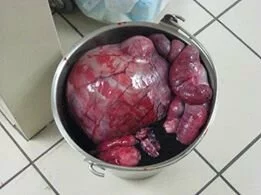 uterine tumor, 30 pounds
TESTICULAR TUMORS are fairly common in uncastrated males and can be life threatening. Neutering your male pig is an absolute requirement if you are to have an enjoyable pet. Otherwise ALL he will think about is sex...where to find it...how to get it. His behavior will be unbearable, as will his odor. Your legs, pilllows, buckets, hay bales...NOTHING will be exempt from his affections. For a healthy and agreeable pet, NEUTER!
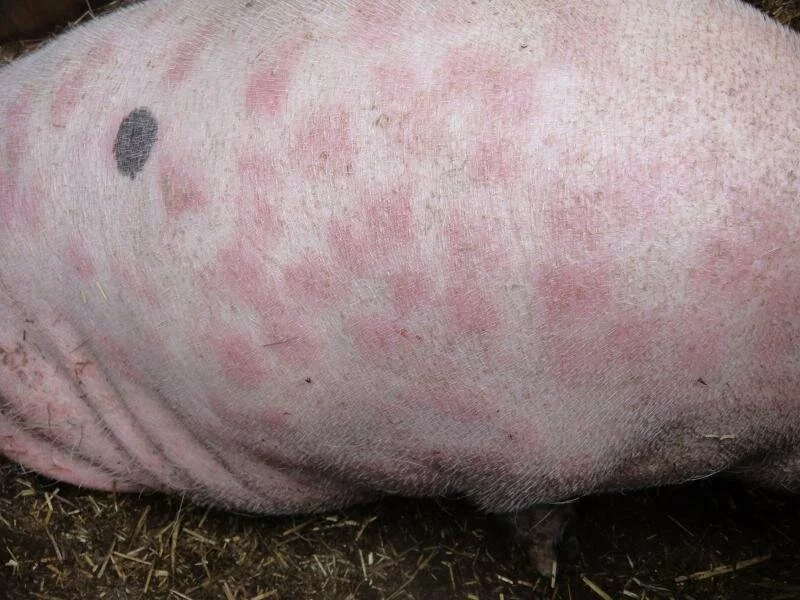
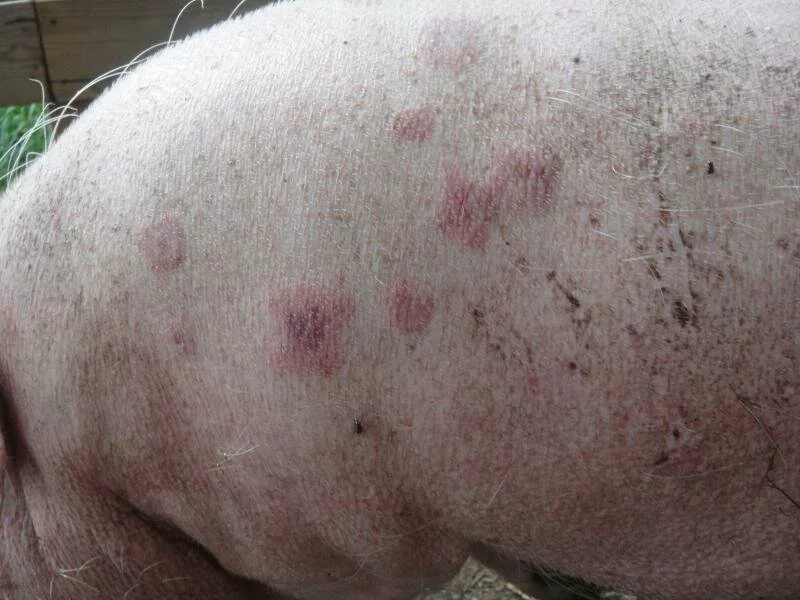
BUMPS on the skin may have several different causes, some relatively minor, some very serious. Even though adult pigs have thick and tough skin, a bite by a horse fly or a bee sting may leave a welt that resembles a hive. An encounter with a nest of bees may leave many welts which may be soothed by a topical ointment. It is important to determine the cause in order to determine a treatment. If the welts appear to be squarish or diamond shaped, spread and are accompanied by a fever and/or listlessness, erysipelas should be considered, even presumed, and treatment must begin immediately. The pig may suddenly spike a high temperature of about 105. Penicillin or Pen-G is most effective, if given in time. The initial injection usually brings about improvement almost overnight. That in itself is a good indication the problem is erysipelas, even if there are no apparent lesions. Treatment should continue for 5-7 days and can be switched to an oral antibiotic such as amoxicillin. This disease is quite common in pigs and can be contracted by humans. It can be picked up from the soil and can be fatal. It's seriousness cannot be stressed strongly enough. If erysipelas is even suspected contact your vet immediately to begin treatment. This disease can kill a young or weak pig but older pigs usually survive if treated, but with severe damage, including sloughing of skin, ears, toes, and internal organ damage, heart issues and arthritis. There is a vaccination available which lasts about six months, but there are many different strains and the vaccination will not protect against all strains. It is never a guarantee that the pig is protected. If there is any doubt as to the cause of bumps or welts on your pig contact your vet immediately to begin treatment. Far better to learn it's a bee sting or fly bites than to lose your pig to a preventable and treatable illness because you didn't treat in time. The pig in these photos has erysipelas. The photos were taken between 12 and 24 hours apart.
Note the "diamond" shape of some of the lesions. Erysipelas is also called Diamond Skin Disease
I have touched on only a few of the potential health problems one might encounter with a pet pig. In some areas where there are feral pigs, diseases such as pseudorabies and brucellosis are a possibility. Do not confuse pseudorabies with the rabies virus. They are totally different. Pigs are seldom at risk of contracting rabies and rarely vaccinated as we might for a dog or cat because a rabies vaccine is not made for pigs. THAT SAID, if you suspect your pig has been in contact with or bitten by a suspected rabid animal, contact your vet immediately to discuss the next step. Likely he will just give the vaccination but you may need to quarantine the pig for up to six months as well. You may also need to talk to your local health department.
Dawn Camp @Camp Skipping Pig
1776 Torrey Hill Rd
Java Center, NY 14082
fax: n/a