CAMP SKIPPING PIG SANCTUARY
Snactuary
Dawn Camp @Camp Skipping Pig
1776 Torrey Hill Rd
Java Center, NY 14082
fax: n/a
- Home
- COMMOM MYTHS in no particular order
- So You Want a Pet Pig!
- About Us
- Beginnings
- YOUR PIG NEEDS...
- WHY DOES MY PIG...?
- HEALTH NOTES
- WHEN YOUR PIG IS SICK...
- Did They Tell You About...
-
FEEDING FOR HEALTH

- PIG WEIGHTS
- MOVE THE PIG (correct bad behavior)
- GILBERT WAS AN ANGRY PIG
- FOR SAFETY'S SAKE...
- DOGS-VS-PIGS
- Hannah Blue and Tooey "Teacups"
- Bugsy
- "Spot"
- Tea Cup and Micro Mini Pigs
- Teacup Myths...NAMING NAMES
- Why Are Sanctuaries Needed?
- SO YOU NO LONGER WANT YOUR PIG
- LINKS
- Swilbur's Story
- Our American Heritage pigs
- ANGELINA AHP
- SNORKLE
- Lia, Burn Study Pig
- Meet the Kunekunes
- Contact Us
- ART WORK
- WHO IS KENYA ?
- SUDAN and TSAVO
- RED WATTLE HOGS
- sNYGYL
- Jack & Jill
- JOY
- SNURDLE
- PETER
- GIZMO
- HARLEY
- SPAMLET
- SNICKERS
- 'LIL WILLIE
- PIGGLES
- RICHARD & REGGIE
- LUCY
- SNIPPET
- SASSY
- Rosie
- Photo Page
- A BIG THANK YOU!
- THE CATS
- Available Pigs
YOUR PIG NEEDS...
HOUSING
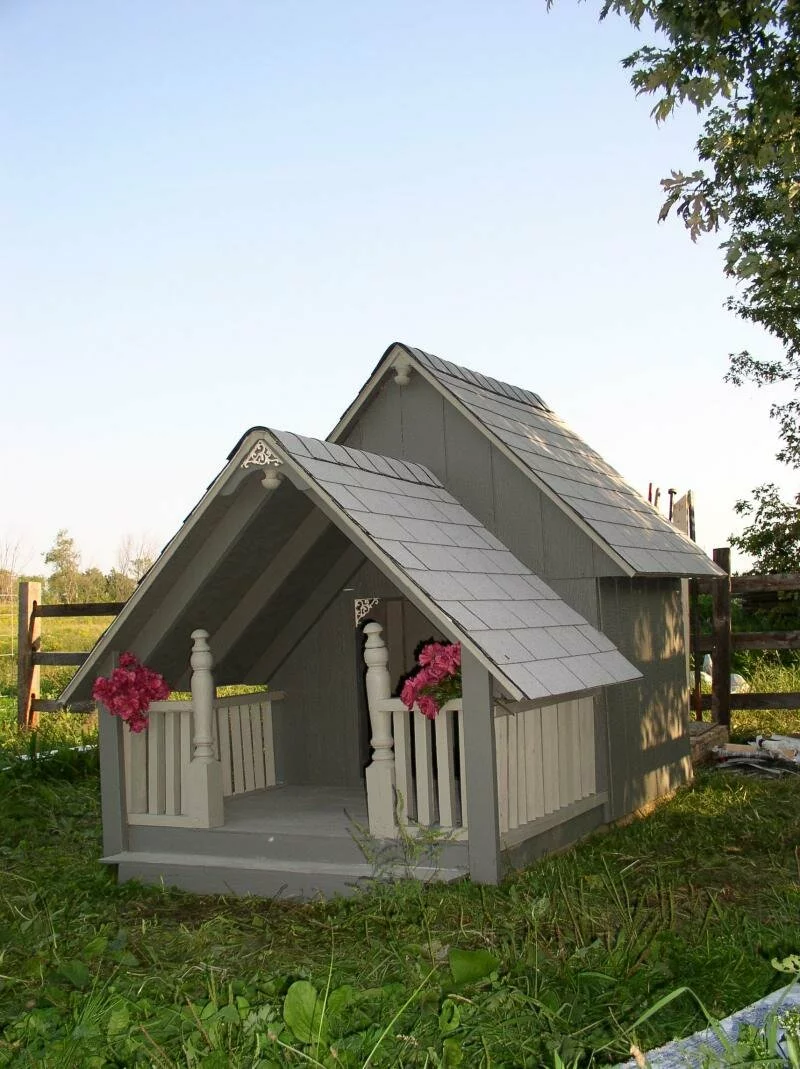
"the Bradford House"
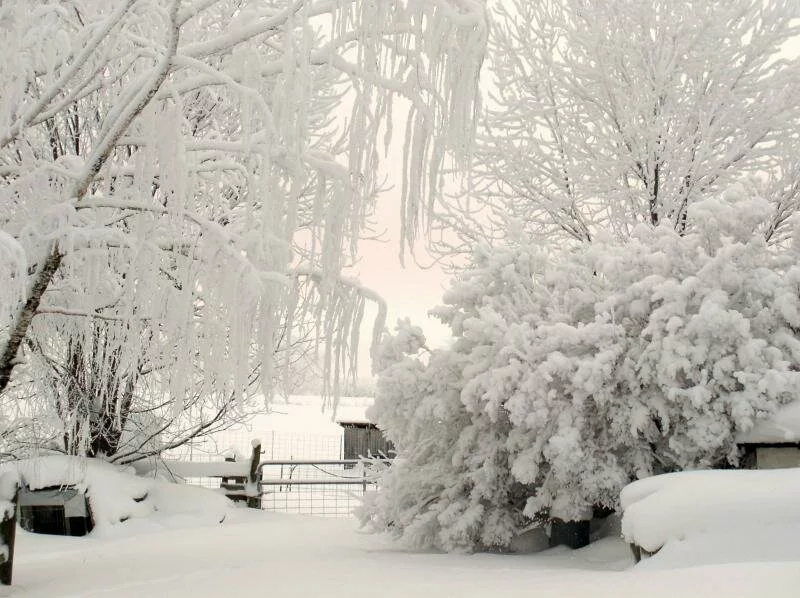
I've found that large dog houses work well for individuals or a pair of pigs that are willing to share. The houses I build are a minimum of 4' x 4' and a porch is added in case the house itself gets too hot on a sunny summer day. As the weather cools I drop a heavy drape over the door to stop drafts. It can be rolled up for the summer and held in place with clips. These houses work well into our cold November weather but when the snow accumulates all pigs move into the main barn. Often the drifts are as tall as the houses.
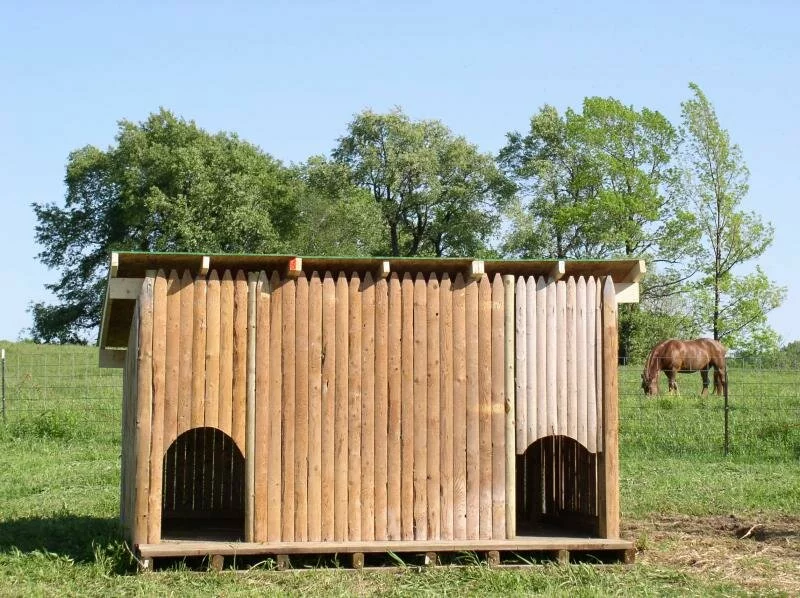
Stockade fence makes great walls for a shelter in a mild climate. It lets a gentle breeze waft through yet offers protection from the rain. We've found it to be perfect for Western New York summers. This shed is not quite completed, but you can get the idea. A group of ten shares this shed which measures about 12' x 8'. The front is made of 6' high fence and the back is 4' high. The ends are tapered 6' pieces. It has a narrow deck across the front for the pigs to lay out on a sunny day. Two doors allow for a hasty exit should a squabble erupt. The shed rests on pressure treated landscape timbers and has a pressure treated floor made of 2" x 6" planks. It can be wrapped with heavy plastic to stop drafts as the days get colder. In 2007 the Kunekune girls happily stayed in it well into November. Carpet drapes were added and a deep bed of hay for nesting made it very comfortable for the girls.
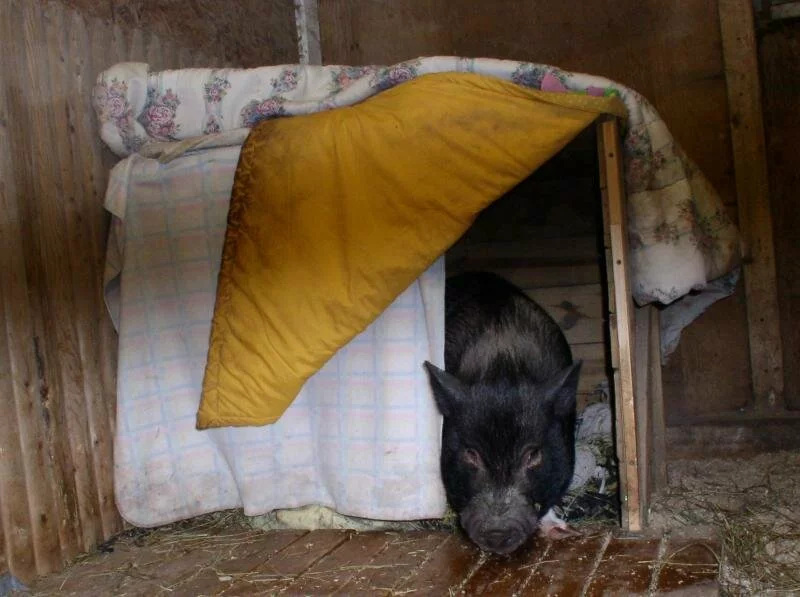
During the winter our pigs move into the barn. Each stall has a large wooden box, a minimum of about four feet by four feet square, that can accommodate a pig or two. Larger pens with larger groups have bigger houses. All are raised off the floor and have a wooden bottom to keep the pigs off the concrete. Heavy blankets cover the doorways and the tops of the boxes have a hole cut out where a brooder lamp with a hood can be placed if needed. We've found that a 75 watt or 100 watt light bulb sufficiently warms the box when the blankets are down and there usually isn't a need for an infared heat lamp except in the case of a weak, cold or sick pig. If an infared lamp is used, the lamp is raised slightly above the hole with a wire grid to allow for ventilation and it's fastened so that there is no way it can be moved or reached by one of the pigs. As always, when using any heat lamps, extreme caution must be taken. The risk of fire is great if the lamp is too close to combustible items or if it is moved or knocked down. I also saw a terribly scarred potbelly that had been severely burned by a heat lamp that was put in her pen for her babies. Always take the time to check the temperature under a heat lamp with your bare hand at the level your pig would be. Also be sure the light is out of reach of a curious pig and that it can't be broken accidently. Be certain as well that your pig isn't able to push its bedding up and too close to the lamp, which will cause a fire. As they build their nest and burrow, the bedding might be well above their backs. Beware, too, that a heat lamp bulb can break free from the screwed in base and drop into bedding, causing a fire. It is safest to put a wire bsket or mesh under the lamp to catch the hot bulb, should that happen.
A PLACE TO ROOT
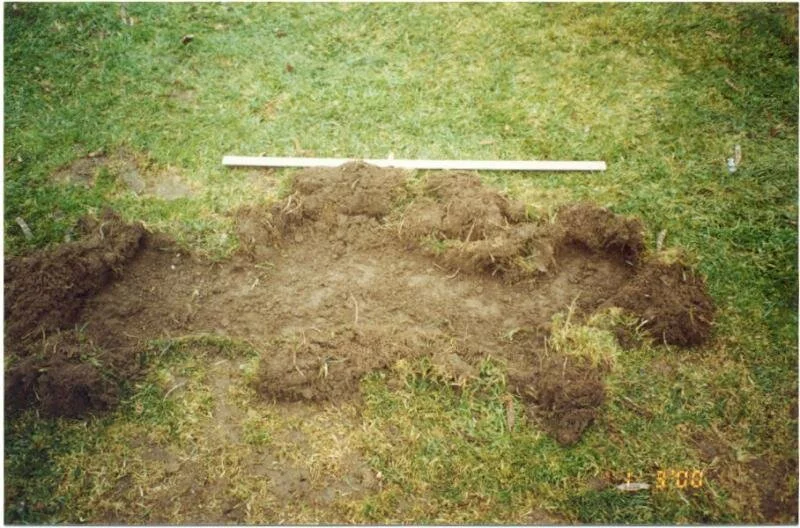
Your pig will need an area where he can just be a pig. He'll instinctively want to root and you must give him a spot where it won't matter if he does. The photo above is of our lawn. It took Ahurei just a few minutes to root up an area almost six feet long in search of dandelion roots. If someone tells you that Kunekunes don't root, let me be the first to say, "they do", and our Kunekunes are the most enthusiastic rooters! Urei is a world class rooter and like most pigs loves the soft ground after a rain or in the spring. He looks for dandelion roots and will either leave countless small divots all over the yard, or will tear up a large area, as in this photo. All pigs will root and nose rings are a cruel means to prevent your pig's natural behavior. If you can't provide a place for your pig to root, don't get a pig. If it's a house pig, it's apt to "root" on your carpet, flooring, bedding, etc. and cause extensive damage. Friends replaced a kitchen floor when their two house pigs rooted it up because they could smell "food" between the joints of the tiles. Some people build a rooting box for their indoor pig and fill it with plastic balls or round stones, but nature intended for a pig to do his digging outdoors. A rooting box can be buit with a 2"x 4" or 2" x6" frame and a plywood bottom. Plastic balls or river rocks work well for the pig to root in as he searches out treats. It gives him something to do and helps to satisfy the need to root, but there's no substitute for the real thing. Some people now are selling rooting rugs for pigs but beware of the pig ripping it and ingesting the fabric. The risk of a blockage is very real.
A SECURELY FENCED AREA
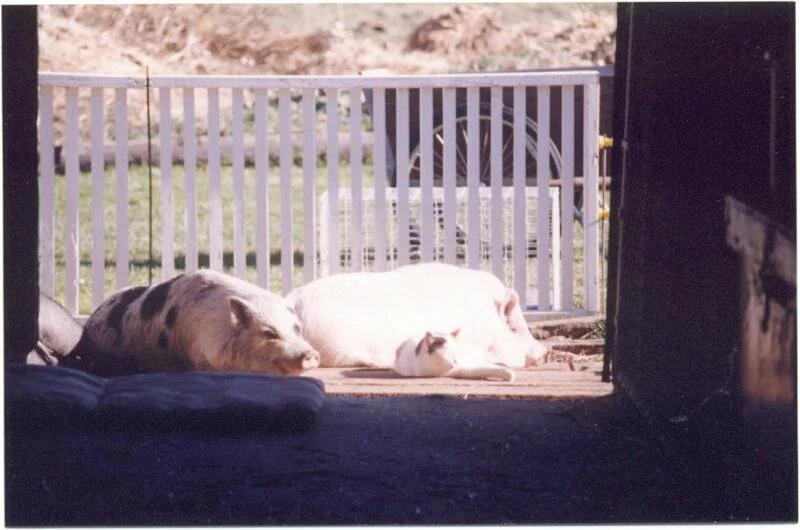
A good fence is important for the safety of your pig and good relations with your neighbors. Some of our interior fences are wood and resemble railings, as in the picture. I've used picket fence but have found that most often the pickets need to be screwed on because the small nails used by the manufacturer allow a pig to easily push the pickets loose. A pig may also get his face or tusks caught in a picket fence. Consider the size of your pig when planning a fence. Other fences are comprised of split rails lined with cattle or hog panels, others are cattle panel only, and still more are electric fencing tape that's charged with a low impedence charger. The electric fences are the internal fence lines, never the perimeter fencing. In my experience, the cattle panels have been the most secure fencing, though one very angry and determined potbelly (Harley) once broke enough of the welds on a panel to escape and attack Bradford. Hog panels can too easily be jumped by a dog or coyote, or even climbed by the pig, and the difference in price between them and the taller cattle panel is minimal, with the taller cattle panels actually being less expensive. I haven't found the newer chain link fencing to be strong enough to contain a determined pig, especially the lightweight kennel sections now sold at the farm stores. The pigs push their noses along the bottom and simply make their exit. The chain link panels are also expensive and it would take many to make an area large enough to keep a pig happy.
SHADE
A reliable source of shade must be provided. When determining where your pig's pen will be, make sure it is never without shade. Watch how the sun moves and plan accordingly. Pigs are unable to cool off by sweating and shade is absolutely critical. Quality shade panels can be purchased thru a farm store or on line. They're sized to fit on a dog kennel and larger ones are available that would fit a greenhouse or tent. They're money well spent if you don't have natural shade available. Purchase the one that offers the maximum shade. There are different levels of protection. A simple lean-to with a slanted roof will provide good shade as well as protection from the rain.
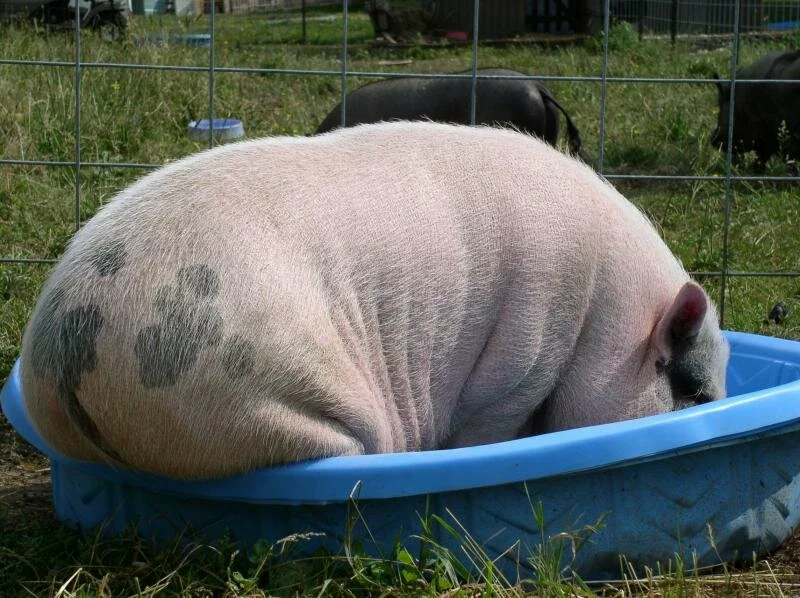 Cleo's owner didn't think she'd like a pool.
A WATER SOURCE
Your pig should never be without a source of fresh water. This may be a challenge for some owners because pigs love to tip their dishes and lay in the spill on a hot day. I've found that a triangular or square box made of pressure treated 2" x 4"s (to prevent rot) with a hole cut in a plywood top (large enough to accommodate a large ceramic crock) works very well for individuals. For a larger group make a box using 2" x 6"s in the same manner that will hold a larger and deeper water tub. During the summer a child's pool will really be appreciated by your pig. We've found the potbellies to be about a 50/50 split for and against the pools. Not all use them, but all have a pool available. The Kunekunes all seem to enjoy a splash and even wade in their water tubs in mid winter when the temperature is in the single digits. We always give them hot water in the winter, but cold water doesn't seem to deter them from wading. Many pigs will urinate and/or defecate in their pool. Some of ours do it frequently and I change the water so often that I've come to believe they think it's a flush toilet! Often during the summer the Kunekune pools are changed at least three times a day! They depend on them as a source of drinking water, as well as to cool off. Though given large water tubs for drinking in addition to the pools for dipping, the Kunekunes manage to soil both.
QUALITY FOOD
Like us, pigs are omnivores and will eat almost anything including vegetation, meat, fruit, nuts, berries, roots, grubs and more, but that doesn't mean they should be fed just anything. They should never be fed meat, though left to their own devices, they will eat it. Feral pigs and wild boar are opportunists and take advantage of whatever is available. The best feed for your pet pig is a pelleted feed made especially for mini pigs. An especially good and popular one is made by Purina and called Mazuri. Tiny babies can start on about 1/4 cup, three times a day with an increase as they grow. Depending on need, add baby cereal and/or oatmeal as well. Even the largest adult gets 1 1/2 to 2 cups a day divided into two meals. Due to our large population, feeding all of the pigs the mini pig diet is too costly, but all young, growing and special needs pigs recieve it. The majority of our pigs recieve a maintenance pellet which can be supplemented as necessary for individuals with Nutrena's Milk Plus pellets or Calf Manna pellets. We also offer high quality timothy, grass and alfalfa mix hay during the winter. Most pigs have access to mixed grass pasture during the milder weather. Fruits and veggies are sometimes provided, but they don't make up a large portion of their diet. They are more of a treat because we do not have access to a good source of produce in quantity.
Salt is toxic to pigs because they can't sweat. If they can't sweat, they can't eliminate it and salt poisoning may be the result. Never feed your pig highly salty foods such as chips or pretzels and snack foods. If a pig gets into a bag of chips that is left within reach, it could be fatal. Limit treats and junk food to reasonable amounts, as in a piece or two, max, per day. At our house even an apple is a treat for six pigs, not one. Veggie treats are given more often than "junk food", but that's not to say that our gang doesn't enjoy a cookie, muffin, or even a single potato chip now and then. The quantities are controlled and treats aren't an everyday occurrance. All meals are pre-measured and if a treat of pellets is offered, it comes out of the pre-measured amount for the day, not the grain barrel. Often people comment on how active all of our pigs are...even the elderly ones. It's because their weight is kept in a healthy range by not overfeeding. They are much happier because they can see, hear and freely move around without the excess baggage caused by obesity.
ATTENTION, AFFECTION & COMPANIONSHIP
Your pig should be given love and attention every day. If you can't or won't provide that, you shouldn't have a pig. They are very social and should never be put in a secluded place and forgotten. Two pigs are best because they'll keep each other company as you go about your daily routine. If you take the time to properly train your pig, give him the love and attention he craves, and provide a healthy, stimulating environment, you'll be rewarded with a delightful pet and companion for many years. Do not get a pig if you cannot spend lots of time withhim. In nature they live in close family groups. You are part of his herd and he needs to be with you.
A QUALIFIED VETERINARIAN
Before your pig arrives home you will need to find a veterinarian willing and able to treat it should the need arise. There will be the initial visit to check his health after you buy him. Think of it as a "well baby visit". There will be spaying or castration if the breeder hasn't already done so. There will be routine vaccinations as your vet recommends as well as the occaisional time when piggy isn't feeling well and requires medical attention. Don't wait for a medical emergency to start looking for a vet! Your pig might die as you desperately search. Do NOT depend on asking for help on FaceBook or a similar forum. You will get a variety of opinions from helpful to useless to downright dangerous. Routine health checks, vaccinations, hoof and tusk trims, dietary advice and parasite control will help your pig to live a long and healthy life as a beloved member of your family. Ask your vet what items are best kept on hand at home in a piggy first aid kit. Many times you'll be able to treat simple things yourself. A few items I always stock are... a digital thermometer ($3 at a discount store), a pad, pen and clipboard to document all symptoms and treatment (logged at least twice a day), Terramycin eye ointment, zinc oxide ointment, triple antibiotic ointment, a pill crusher, oral syringes, small plastic cups for mixing meds, apple sauce, canned pumpkin pie filling, bran, unflavored Pedialite, cotton swabs, sunscreen and ivermectin wormer. Keep track of expiration dates on medications and ointments and replace items as necessary. A check of your inventory every few months is usually sufficient. As I've become more experienced and comfortable diagnosing and treating my pigs, and out of necessity due to the expense and timing (sometimes late night, weekends and holidays) of the vet calls, I also stock syringes, assorted size needles, a couple of good broad spectrum antibiotics in powder, liquid, injectable, and tablet form, medication for pain relief, an injectable steroid (anti-inflamatory), prednisone tablets, and more. Almost every treatment is done only after consulting with my vets, who offer suggestions as to appropriate treatment and dosage for the symptoms presented. Having a variety of medications readily at hand lets me begin treatment as soon as possible after a phone consultation rather than delay treatment until the following day or longer when an appointment can be scheduled. It's also saved the vets many a late night emergency trip to our farm. I have a great working relationship with my vets and over the years they've come to realize there are no "frivolous" calls. If I call them it's because there's a problem I need help with. We work closely together for the benefit of the pigs. Though many people are uncomfortable giving injections and pigs are often not the most cooperative patients, there are still many things a responsible pig owner can do on his/her own if necessary. A good relationship with your vet is a critical first step.
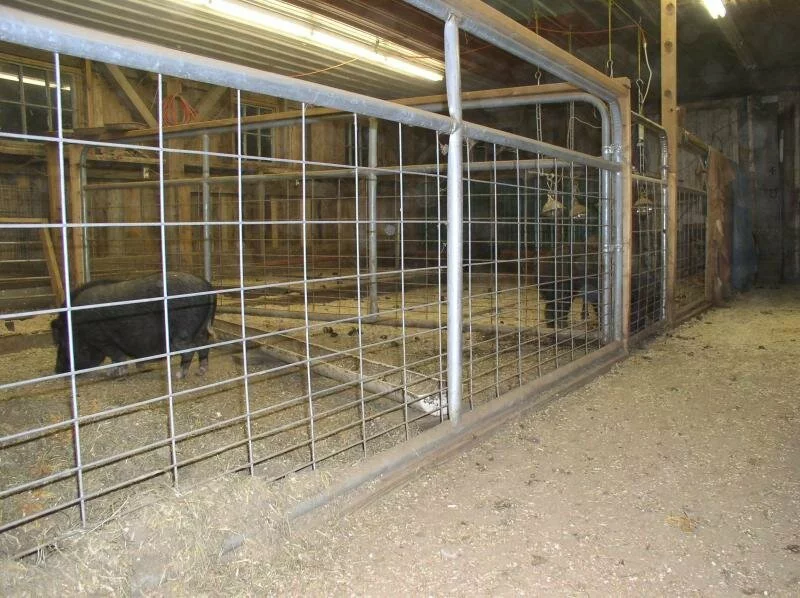 In addition to stalls with solid, draft free walls, some of the interior pens consist of combo panel gates. These provide safe and secure fencing for larger groups of pigs and allow them to visit with each other. The open and airy pens are healthier for pigs with no health issues or those who need to be in smaller areas. I like to be able to look down through that section of barn and see most of the pigs at a glance. There is a need for solid walled stalls for isolating a sick pig, quarantining a newcomer or to provide a draft free and easy to warm area for an elder pig. Otherwise I prefer the openess of the panel gates. When all of the pigs are in for the winter the barn temperature is usually between 38 and 43 degrees F...comfortable for well bedded pigs with sleeping buddies.
TRAINING
You will need to dedicate time and effort to training. Failure to do so will result in an ill mannered pig who trains you. There is a lot if useful information available but know that striking the pig, squirting with a water bottle ir swatting with a newspaper is NEVER APPROPRIATE. That is NOT how pigs communicate and it is not a substitute for proper training. Start young and reinforce/reward good behavior on a daily basis.
Here is also a GREAT link to valuable information for anyone who wants or who already has a pet pig
Save it as a "Favorite" for quick reference! http://www.minipiginfo.com/
Dawn Camp @Camp Skipping Pig
1776 Torrey Hill Rd
Java Center, NY 14082
fax: n/a